

There is a particular kind of journey that only Kansai can offer — one where the morning is spent inside one of Japan’s most respected corporations, studying the management philosophy that built a global empire, and the evening ends in a thousand-year-old hot spring with kaiseki on the table and mountains through the window. This is not a holiday. It is something rarer: a week that sharpens the mind and restores the body in equal measure.
Across seven days, the route draws a wide arc through the cultural and commercial heart of western Japan — Osaka, Kobe, Himeji, Kyoto, and Shiga — threading together corporate insight, architectural mastery, World Heritage castles, Michelin-starred kitchens, and one of the oldest onsen towns on Earth. A dedicated vehicle, Chinese-speaking interpreter, and personal travel concierge accompany you throughout, scaled precisely to your group size, ensuring that every meeting, every transfer, and every reservation unfolds without friction.

Day 1 · Osaka — Arrival in the Merchant City
The journey begins at Kansai International Airport, where a private car is waiting. The drive into central Osaka takes roughly an hour, enough time to watch the bay give way to the dense, energetic skyline of Japan’s second city — a place that has called itself the nation’s kitchen for centuries and has never been wrong.
After settling into the W Hotel Osaka — all floor-to-ceiling windows, contemporary design, and a location overlooking the Nakanoshima waterfront — the afternoon offers a first encounter with the city’s architectural ambition. The Umeda Sky Building, a twin-tower monument of steel and glass connected by a floating garden observatory at its summit, provides a 360-degree panorama of Osaka stretching to the mountains. The building was selected for a prestigious international ranking of the world’s most innovative structures, and standing on its open-air rooftop deck, the reason is immediately clear: the city unfolds beneath you like a circuit board, vast and humming with purpose.
Dinner sets the tone for the week. Ajikitcho, a Michelin one-star restaurant rooted in Osaka’s culinary heritage, serves kaiseki that balances tradition with invention — seasonal ingredients prepared with the precision and reverence that define Osaka’s claim to Japan’s culinary throne. This is not merely a meal. It is a statement of intent for the days ahead.
🏨 W Hotel Osaka

Day 2 · Kobe — Harbour, Heritage & the Architecture of Light
The morning drive to Kobe takes less than an hour but crosses into a distinctly different atmosphere — a port city pressed between mountains and sea, cosmopolitan from birth, where Western and Japanese cultures have coexisted since the harbour opened to foreign trade over 150 years ago.
The Kitano Ijinkan district preserves that history in a hillside neighbourhood of Victorian and colonial mansions, built by the European and American merchants who made Kobe their home. The interiors are immaculately maintained — period furniture, stained glass, imported wallpaper — and the effect is of walking through a living museum of the city’s international origins. From the hill, the view stretches across rooftops to the harbour below.
At Kobe’s waterfront, Meriken Park and Harborland frame the port with promenades, the iconic red Kobe Port Tower, and a commercial district where business and leisure coexist with natural ease. The afternoon turns to architecture of a different order: the Ando Gallery, dedicated to the work of Tadao Ando, whose concrete-and-light philosophy has reshaped modern architecture worldwide. For anyone with an eye for design or construction, this is essential viewing — the models, drawings, and philosophy collected here reveal how discipline and imagination can coexist at the highest level.
By evening, the car climbs into the mountains behind Kobe and arrives at Arima Onsen, one of Japan’s three most celebrated hot spring towns, cherished for over a thousand years. The mineral-rich golden waters — kinsen, coloured by iron and salt — are unlike any other onsen in the country. Dinner is traditional kaiseki served in the ryokan, followed by a long, restorative soak. The boardroom can wait until morning.
🏨 Arima Onsen ryokan

Day 3 · Enterprise & Empire — From the Boardroom to the White Heron
The morning is reserved for a corporate site visit — an opportunity to observe Japanese business operations firsthand and engage with local industry leaders. The specific arrangement is tailored to your delegation’s sector and objectives, coordinated in advance by your travel concierge.
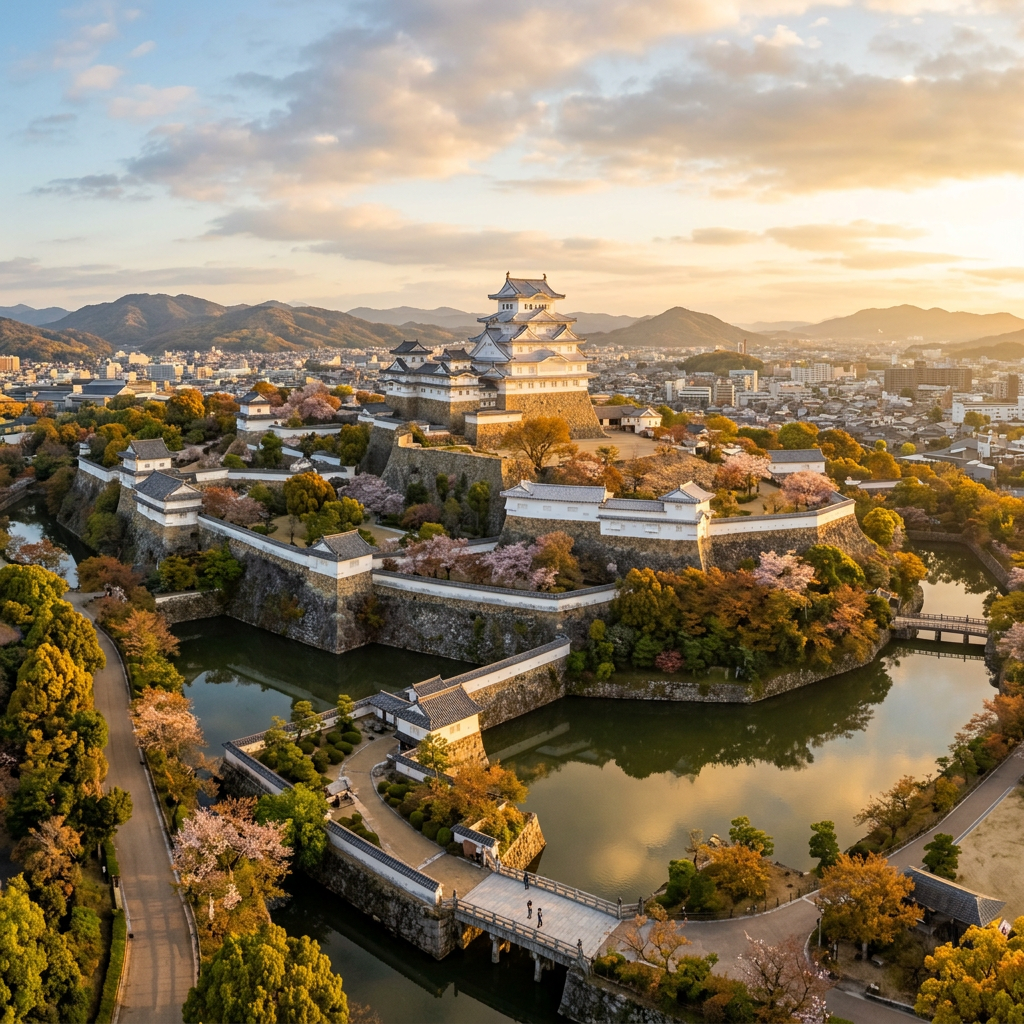
The afternoon shifts from commerce to history. Himeji Castle — a UNESCO World Heritage Site and the finest surviving example of Japanese castle architecture — rises above the city like a white heron poised for flight. Its exterior has been restored to a breathtaking brilliance, and the interior climb through steep wooden staircases and defensive corridors reveals the military engineering beneath the beauty. Adjacent to the castle, Koko-en Garden recreates the elegance of Edo-period landscape design across nine distinct walled gardens, each one a study in controlled perfection.
The drive back toward Kobe crosses the Akashi Kaikyo Bridge, the world’s longest suspension bridge, its cables strung across the strait like a feat of engineering poetry. A free hour in the Sannomiya shopping district offers a taste of Kobe’s commercial energy before the evening returns you to the golden waters of Arima.
🏨 Arima Onsen ryokan

Day 4 · Kyoto Corporate Visit — The Philosophy Behind the Empire
Today’s focus is the visit to Kyocera Corporation, the global ceramics and electronics conglomerate founded by the legendary Inamori Kazuo. The tour offers more than a factory walk — it is an immersion in the management philosophy known as the Amoeba System and the guiding principle of “Respect the Divine and Love People,” a framework that transformed a small Kyoto ceramics workshop into a Fortune Global 500 enterprise. For business leaders seeking to understand what makes Japanese corporate culture endure, this is the essential classroom.
The drive from the Kyocera facilities to the Arashiyama district of western Kyoto takes less than thirty minutes but crosses a thousand years. The evening arrives quietly among bamboo groves and riverside inns, where Kyoto reveals its most intimate face.
🏨 Kyoto Arashiyama hotel or ryokan

Day 5 · Kyoto — Bridges, Castles & the Living Arts
The morning belongs to Arashiyama itself. The Togetsukyo Bridge spans the Katsura River with the mountains rising behind it — a view that has inspired poets for a millennium and looks exactly as they described it. Walk slowly. The river, the light, and the forested slopes are Kyoto at its most elemental.
By midday, the route leads to Nijo Castle, another UNESCO World Heritage Site and the Kyoto seat of Tokugawa shogunal power. The castle’s “nightingale floors” — engineered to chirp underfoot as a security measure against intruders — are one of Japan’s most ingenious architectural details, and the painted sliding doors of the Ninomaru Palace represent the pinnacle of Edo-period decorative art.
The afternoon offers something singular: a performance at the Gion Corner arts venue, where the traditional disciplines of Kyoto are presented in concentrated form — Kyo-mai dance, tea ceremony, ikebana flower arrangement, and other classical arts, each one performed by practitioners carrying centuries of inherited technique. It is not a show. It is a window into the aesthetic principles that underpin Japanese culture at its most refined.
Dinner is at Nanzenji Junsei, a celebrated restaurant beside the great Nanzenji Temple, specialising in yudofu — Kyoto’s signature tofu kaiseki. The soft tofu is simmered gently in kombu broth and served in a tranquil garden setting. It is a meal of extraordinary simplicity and quiet depth, exactly like Kyoto itself.
🏨 Kyoto Arashiyama hotel or ryokan

Day 6 · Shiga — A Museum in the Mountains, a Lake Like an Inland Sea
The final full day turns east, across the border into Shiga Prefecture, where the architect I.M. Pei — the mind behind the Louvre Pyramid — created one of his most poetic works. The Miho Museum is built into a forested mountainside, approached through a tunnel and across a suspension bridge that frame the arrival as a kind of pilgrimage. The collection spans ancient civilisations — Japanese, Chinese, Egyptian, Greek, Roman — displayed in galleries where natural light pours through geometric skylights and the boundary between architecture and landscape dissolves entirely. For those who visited the Ando Gallery in Kobe, the Miho offers the perfect counterpoint: two of the twentieth century’s greatest architects, in dialogue across the same week.
From the museum, the road descends to Lake Biwa, Japan’s largest freshwater lake and a body of water so vast it resembles an inland sea. The mountain-framed shoreline stretches beyond sight, and the lake’s ecological and cultural significance — it has sustained the Kansai region for millennia — adds a dimension of reverence to the view.
The evening returns to Osaka and the W Hotel, where the Shinsaibashi and Dotonbori districts await. This is Osaka at its most exuberant — neon-lit arcades, street food stalls, takoyaki vendors, and a commercial energy that never quite sleeps. A final night for shopping, eating, and letting the city remind you that Japan’s merchant capital still knows how to celebrate.
🏨 W Hotel Osaka

Day 7 · Osaka — Farewell to Kansai
The final morning is quiet. Breakfast at the W, perhaps a last walk along the Nakanoshima riverbank, and then the private car to Kansai International Airport, timed precisely to your flight.
Seven days across the breadth of western Japan. The boardrooms of Kyoto, the castles of Himeji, the golden springs of Arima, the masterworks of Ando and Pei, and the kitchens of Osaka — each one a different lens on a civilisation that has spent centuries refining the art of doing things well. You leave with more than memories. You leave with understanding.
What’s Included: Private vehicle with driver for all seven days · Chinese-speaking interpreter · Dedicated travel concierge · Airport transfers · Hotel accommodations (6 nights including W Hotel Osaka and Arima Onsen ryokan) · Corporate visit coordination and arrangements · Michelin dinner at Ajikitcho · Kaiseki dinner at Nanzenji Junsei · Vehicle scaled to group size: Toyota Alphard (2–3 guests) · Toyota HiAce (4–5 guests) · Executive Coaster (9+ guests) · Fully customizable itinerary
※ Dining arrangements can be adjusted to suit dietary preferences and requirements.
📩 Contact MINAMOTO Travel for pricing and custom arrangements.