

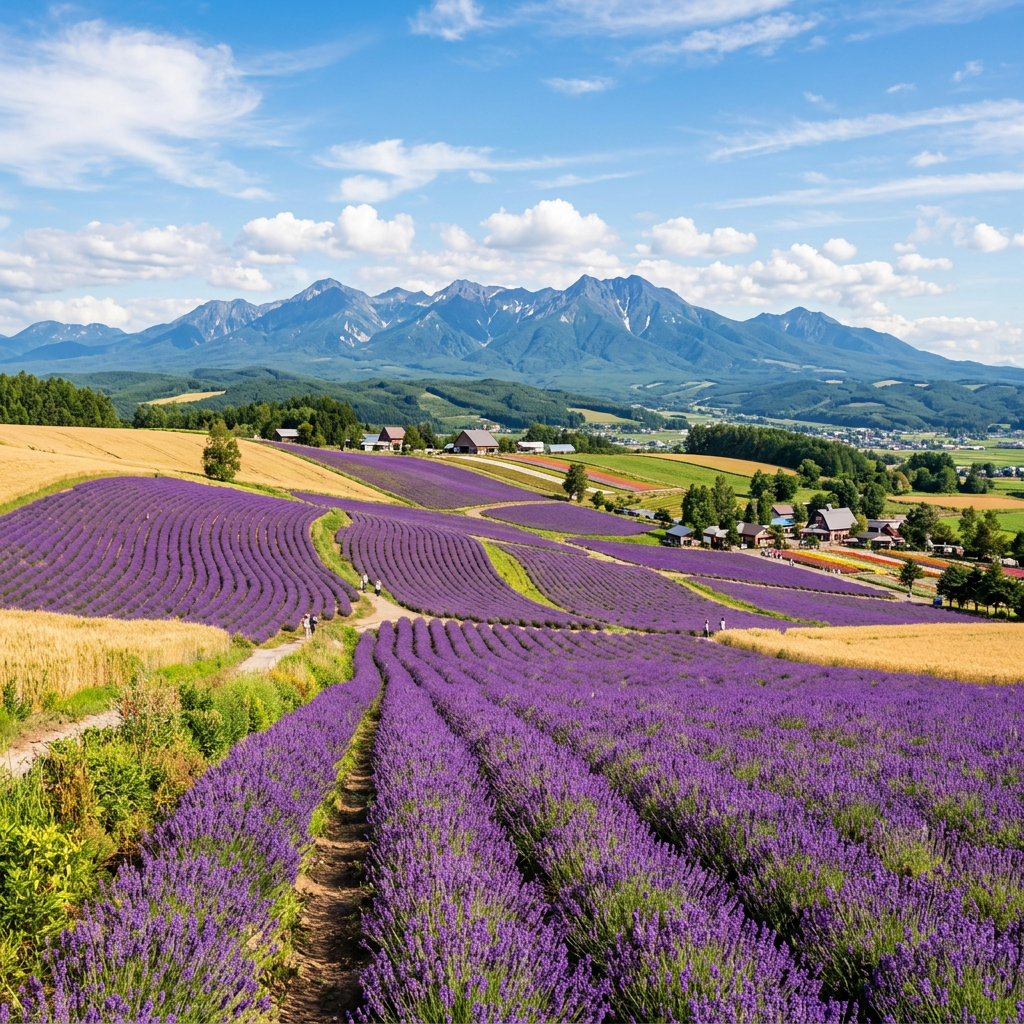
There is a version of Japan that only exists between June and August, and it lives on the northern island. Hokkaido in summer is a different country — cooler, slower, impossibly green, where lavender fields dissolve into blue mountains and the seafood tastes like the ocean just decided to be generous.
This six-day journey begins and ends in Sapporo, looping through the romantic port town of Otaru, the pastoral dreamscape of Furano and Biei, the sacred stillness of a hidden Buddha, the crystal depths of Lake Shikotsu, and the volcanic hot springs of Noboribetsu. It is not a tour. It is a slow, deliberate unwinding — by private car, at your own pace, through the best of what Hokkaido offers when the island is at its most alive.

Day 1 · Sapporo — The Northern Capital Awakens
The journey begins in Sapporo, where the afternoon light falls long across Odori Park’s flower beds and the city hums with a relaxed energy that Tokyo never quite manages. Sapporo is a city built on a grid — wide avenues, open sky, a sense of space that feels almost North American — and in summer it comes into its own. The lilacs have finished, the beer gardens have opened, and the evening air carries just enough chill to remind you that you are very far north.
Walk the full length of Odori Park, from the Television Tower at its eastern edge to the fountains at its western end. Browse the underground shopping arcades of Tanukikoji, where eight covered blocks of boutiques and cafes have been serving Sapporo since the Meiji era. As evening falls, follow the locals to the ramen alley of Susukino, where a steaming bowl of rich miso ramen — Sapporo’s signature gift to the world — is not just dinner but initiation. The broth is thick, the butter melts slowly into the noodles, and the corn kernels are sweet from Hokkaido’s own fields. This is where the journey starts: full, warm, and curious about what lies ahead.
🏨 Sapporo city hotel

Day 2 · Otaru — Canals, Glass & the Catch of the Day
A forty-minute drive northwest brings the sea into view, and with it the storybook port town of Otaru. Once Hokkaido’s financial capital and busiest trading port, Otaru has aged into something lovelier — a town of stone warehouses converted into galleries, canal-side walkways lit by gas lamps, and a glassblowing tradition that fills entire streets with shimmering, light-caught art.
The morning belongs to the Otaru Canal, where the old warehouse district lines the water with an elegance that feels almost European. Step inside the glass workshops of Kitaichi and watch artisans shape molten glass into delicate ornaments, wine glasses, and jewelry. The craft has been Otaru’s signature for over a century, and the quality is extraordinary.
By midday, the conversation turns to seafood. Otaru’s Sankaku Market is a corridor of vendor stalls selling the freshest catch in Hokkaido — sea urchin so sweet it barely tastes of the ocean, crab legs cracked and served on the spot, scallops grilled over charcoal until the edges caramelize. Order a kaisendon — a bowl of rice buried under layers of raw seafood — and eat it standing at the counter, surrounded by locals doing exactly the same thing.
The afternoon is free for wandering. Climb the hillside streets for views of the harbor, or visit the Music Box Museum, where hundreds of antique mechanical music boxes fill a Victorian-era warehouse with tinkling, overlapping melodies. By late afternoon, the car returns you to Sapporo with salt air still on your skin and the taste of the sea still fresh.
🏨 Sapporo city hotel

Day 3 · Furano & Biei — A Lavender Sea Under Open Sky
Today the road turns inland, climbing gently for two and a half hours into the heart of Hokkaido. The landscape opens in every direction — farms, forests, volcanic peaks on the horizon — and then, somewhere past the last small town, the lavender begins.
Furano in summer is one of the great visual spectacles of Japan. The lavender fields of Farm Tomita roll across gentle hillsides in stripes of violet, white, pink, and orange — each color a different variety, planted in deliberate bands that look like brushstrokes on the land. The fragrance reaches you before the fields do, carried on a breeze that smells like the south of France imagined by the north of Japan. Walk between the rows. Breathe. There is lavender ice cream to eat, lavender sachets to buy, and — if the light is right — a photograph to take that will make everyone you know want to be here.
From Furano, the drive continues to Biei, where the Patchwork Road earns its name. The landscape here is agricultural, but on a cinematic scale — vast geometric fields of wheat, potatoes, corn, and wildflowers, stitched together across rolling hills with a precision that looks curated but is simply the result of Hokkaido’s enormous farm plots and the endless summer light. The iconic trees of Biei — lone oaks and poplars standing in the middle of fields, each one famous enough to have a name — punctuate the view with a loneliness that is somehow comforting.
Dinner tonight is Furano’s own contribution: rich, creamy local cheese and farm-to-table cuisine prepared with vegetables pulled from the earth that morning.
🏨 Furano area hotel or pension

Day 4 · Sacred Buddhas, Crystal Waters & Volcanic Springs
This is the day the journey turns south, and the landscape shifts from pastoral to primordial. The car leaves the Furano area in the morning and drives toward the outskirts of Sapporo, where one of Hokkaido’s most extraordinary secrets waits inside a hill.
At Makomanai Takino Cemetery, the architect Tadao Ando placed a thirteen-meter stone Buddha inside a man-made mound of earth and lavender. Approaching on foot, you see only the crown of the Buddha’s head rising above a carpet of purple flowers. A long concrete tunnel draws you inward, and the full figure is slowly revealed — seated, serene, enormous — framed by an oval of open sky above. The silence is total. Ando designed this space so the sacred is not elevated above nature but held within it, and the effect is unlike anything else in Japan.
By noon, the road reaches Lake Shikotsu, a volcanic caldera lake of staggering clarity. Shikotsu is Japan’s northernmost ice-free lake and its water is ranked among the clearest in the country — standing at the shore, you can see stones on the bottom many meters down, the light shifting through aquamarine and cobalt. Lunch is taken lakeside: grilled Himemasu trout, local ramen, and seafood fresh enough to justify the drive alone.
The afternoon continues south to Noboribetsu, where a stop at the Bear Park offers close encounters with Hokkaido’s brown bears — massive, expressive animals that catch tossed treats with surprising grace. Then the walk through Hell Valley, Jigokudani, where steam erupts from fissures in pale, mineral-streaked rock and pools of boiling water glow an unearthly blue-grey. The earth here is alive and restless, and the boardwalk carries you through it like a visitor to another planet.
By evening, the onsen hotel receives you. Noboribetsu’s volcanic springs produce nine different types of mineral water, and the finest ryokan channel them into baths that range from sulfurous to iron-rich to silky smooth. Three properties define the area: the garden-wrapped elegance of Sekisuitei, the grand, century-old bathing halls of Dai-ichi Takimotokan, and the refined privacy of Bourou Noguchi Noboribetsu, where each room has its own onsen and the kaiseki dinner borders on art. Choose the one that suits your temperament. All three deliver the same promise: a soak in waters drawn from the belly of a volcano, under a sky full of stars.
🏨 Noboribetsu Onsen hotel — Sekisuitei / Dai-ichi Takimotokan / Bourou Noguchi Noboribetsu


Day 5 · A Morning in Steam, an Afternoon by the Sea
There is no reason to rush this morning. The onsen is still warm, the breakfast is kaiseki, and the mountain air through the window carries the faint mineral scent of the springs below. Take one final soak — morning light on volcanic water is a different experience entirely — and let the day begin gently.
The drive back to Sapporo takes roughly ninety minutes, arriving in time for lunch at Nijo Market, the city’s beloved seafood bazaar. Here the stalls overflow with king crab legs, glistening ikura salmon roe, fat scallops, and uni served in its own shell. It is louder, livelier, and more joyful than any supermarket has a right to be, and the quality is the best Hokkaido has to offer — which is to say, the best in Japan.
The afternoon belongs to Sapporo’s own pleasures. The Tanukikoji shopping arcade is the place for Hokkaido souvenirs — Royce’ chocolate, Shiroi Koibito cookies, Yubari melon sweets, and beautifully packaged local sake. The streets around Sapporo Station offer department stores and fashion boutiques. And if the legs are tired from five days of exploration, a visit to one of Sapporo’s city onsen — quieter, more urban, no less restorative — is a fine way to close the circle.
Dinner tonight is a celebration. Choose the freshest sushi counter you can find, or a Genghis Khan lamb barbecue restaurant, where Hokkaido’s own lamb is grilled at the table on a domed iron plate — smoky, tender, and uniquely northern. This is the last evening. Make it count.
🏨 Sapporo city hotel

Day 6 · Sapporo — One Last Look North
The final morning is unhurried. Perhaps a walk through the Hokkaido University campus, where the famous poplar-lined avenue creates a cathedral of green in summer. Perhaps one last bowl of miso ramen, eaten slowly, as a farewell. The bags are packed, the car is waiting, and the airport is close.
Six days is not long. But Hokkaido in summer does not operate on ordinary time. The light lingers until nearly nine in the evening. The air holds you gently. And the memories — of lavender and lake water, of steam and stone Buddhas, of crab eaten standing up and stars seen from a volcanic spring — do not fade quickly. They stay with you, the way the north always does.
What’s Included: Private vehicle with driver for all six days · Chinese-speaking guide · All intercity transportation · Hotel accommodations (5 nights) · Onsen ryokan stay in Noboribetsu with kaiseki dinner · Fully customizable itinerary and daily pace
📩 Contact MINAMOTO Travel for pricing and custom arrangements.